
|
WAAP + ZTNA · Web Application & API Protection with Zero-Trust Access
One Inline Layer for Every App, API and UserGajWAF is a WAAP (Web Application & API Protection) platform with built-in zero-trust access. It inspects every request and response in line — blocking injection, bots, account takeover, API abuse and data leaks — while its zero-trust access gateway verifies users on every request, and adaptive identity risk can follow a person across your apps. Run it from a browser console, on-premises, in the cloud or in a container. Request a Demo See Capabilities |
|
|
Complete WAAP + ZTNA
WAF · API Security · Bots · Zero-Trust Access
|
Deployment
On-Premises · Cloud · Container
|
Compliance Evidence
PCI DSS · HIPAA · GDPR · DPDP · CERT-In · ISO 27001
|
Five Tools, Five Consoles. Gaps In Between.
Most organisations stitch together a web firewall, an API gateway, a bot tool, a zero-trust access broker and a reporting pipeline — each bought, integrated and operated on its own. The result is more to run, more to tune, and blind spots where the products don't overlap. That is why industry analysts now treat these as one category: Web Application and API Protection, or WAAP.
|
Gap 1 · Watching, Not Blocking
Many tools are alert-only or inspect sampled traffic. Attacks that aren't sampled — or are only alerted on — still reach the application. |
Gap 2 · Signatures Only
Signature matching misses attacks it has never seen. Zero-days and novel API abuse pass straight through until a rule is written. |
Gap 3 · Data Leaves Your Control
Cloud-hosted WAF services route your traffic and logs outside your environment — and hand auditors raw logs someone has to interpret. |
GajWAF Is a Complete WAAP + ZTNA Platform in One Layer You Own
GajWAF combines web application protection, API security, bot defence, zero-trust access, adaptive identity risk and data-leak prevention in a single inline layer — one that you run, tune and own.
Built to block, simple to run, yours to own — here are the four reasons security and IT teams choose GajWAF to protect their web applications and APIs.
Inline, Not SampledFull request and response inspection in the traffic path with about 0.2 ms of overhead — it blocks attacks, it doesn't just alert. |
Run It From a BrowserCertificates, rules, schemas, sites, bans and reports are all managed in the console — no command line, no files to hand-edit. |
Deploy AnywhereYour own servers, the cloud or a container. No endpoint agents, no cloud dependency, works fully offline. |
Audit & Compliance ReadyBranded, scheduled reports and evidence mappings for HIPAA, PCI DSS, GDPR, India DPDP/CERT-In and ISO 27001. |
One Inline Layer for Every App, API and User
GajWAF sits in the traffic path, inspects every request and response, and forwards only clean traffic to your applications.
| Users, bots & API clients All inbound web and API traffic | GajWAF Verifies who sent each request, inspects it, and blocks attacks, abuse and data leaks | Your web apps & APIs Receive only clean traffic; no agents installed |
Ten capabilities, one console
Your Protection at a Glance
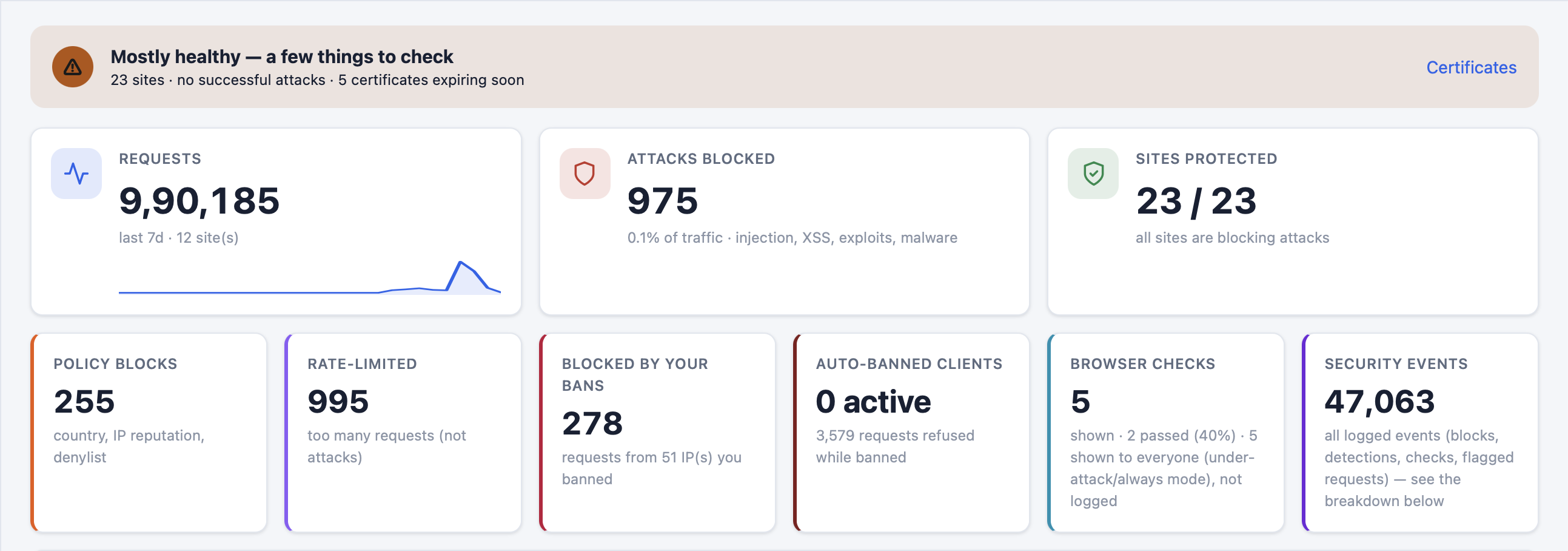
The GajWAF dashboard shows what's being blocked, which sites are protected and what needs your attention — all in the browser, with no command line.
See Where Attacks Come From
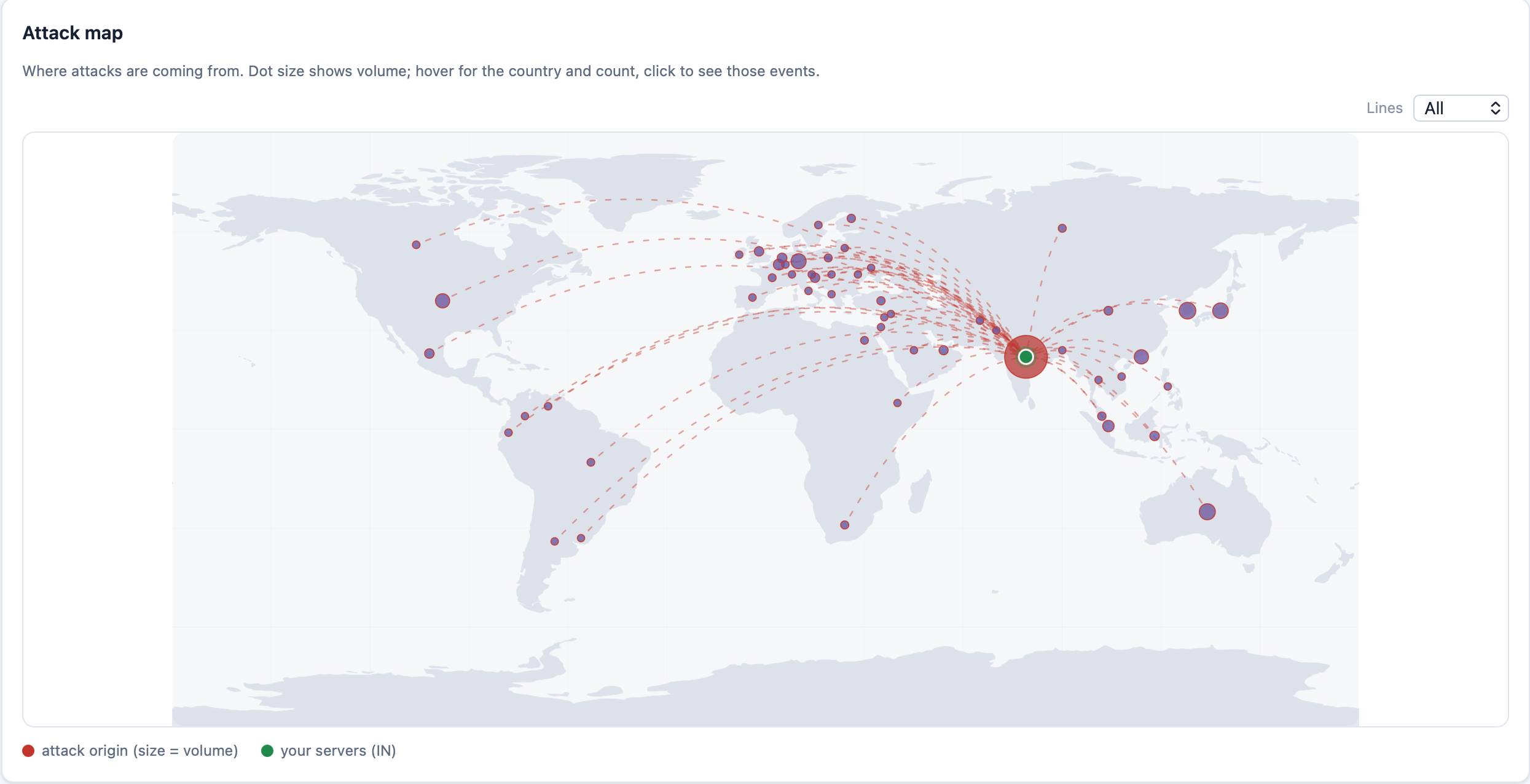
Attacks on your web applications and APIs arrive from every continent. The GajWAF attack map shows each origin country and its volume — and with country rules, IP reputation and threat-intelligence feeds, you decide what gets through.
Why GajWAF Is Different
How GajWAF as a single WAAP + ZTNA layer compares with the typical stitched-together approach.
| Typical Approach | GajWAF | |
|---|---|---|
| One layer, not many | Separate products for web attacks, APIs, bots and access — each run on its own | Web apps, APIs, bots, zero-trust access and data-leak prevention in a single layer |
| Attack and access, one engine | Separate WAF and access broker: one sees the attack, the other the person | Attack and access share one context: an attack raises that user's risk |
| Risk follows the person | Each request on each app judged in isolation | One risk picture per person drives step-up or lock-out across apps |
| Enforce, don't just watch | Often alert-only or inspecting sampled traffic, leaving gaps | Inline on every request and response — it blocks, with negligible added latency |
| Anyone can run it | Specialists, command-line tooling and risky manual rule edits | Guided browser console, watch-only mode, one-click undo and one-click fixes for false alarms |
| Catches the unknown | Signature matching only — misses attacks it has never seen | Signatures plus behaviour, machine learning and a model that learns each site's normal traffic |
| Your data stays yours | Cloud service where your traffic and logs leave your control | Runs in your own environment — on-premises, cloud or offline — so data never leaves it |
| Proof, not just logs | Raw logs that someone has to collect and interpret | Board-ready and compliance-mapped reports, generated on demand or scheduled and emailed |
Protect Every App. Recognise Every User Across Them.
GajWAF works in two layers in one inline engine: attack protection tuned to each application, and adaptive security that follows the person to every app they touch.
Per-application protection, per-person risk
|
WAAP · Per Application
Attack protection
|
Identity Risk · Per Person
Adaptive security
|
In practice: apps in one shared risk domain
| On App A Failed sign-ins from a new country raise the user's risk. | On App B An attack seen on the same user's session raises it further. | At App C The user arrives already elevated, and must pass MFA step-up or is locked out. |
You decide how far risk travels
Every risk picture is keyed to domain · identity provider · user. One setting on the authentication gateway — the identity-risk security domain — decides which applications share it.
|
Default · Left Blank
Per-application, isolated
|
Shared Risk Domain
Cross-application adaptive
|
| ExplainableEvery risk-triggered step-up names the factors behind it, so operators act instead of guess. | Self-healingRisk decays over time and persists across restarts, so users are not penalised forever. | Tamper-resistantManipulation is bounded: an attacker cannot push a score up or wash it down. |
Zero-trust access: every request proves who it is
GajWAF puts an identity-aware sign-in gateway in front of each application. No request reaches the backend until GajWAF knows who sent it, and access is decided again on every request, using the person's current risk.
|
SSO · Directories
Identity-aware sign-in gateway
|
Least Privilege
Authorization on every request
|
|
Context · Device
Continuous verification
|
MFA · Revocation
Step-up and instant revocation
|
| Replace VPN accessGive staff and contractors access to specific applications, not your whole network. | Contain compromised accountsA valid login used by the wrong person is caught by its behaviour and forced to re-authenticate. | Serve many tenants safelyIdentity and risk stay isolated per tenant and identity provider, ideal for MSPs and hosting. |
Six WAAP Pillars: Web, API, Bot & Data Protection
Threat detection, API security, bot and abuse defence, data protection, access control and operations — in a single firewall.
|
|
|
|
|
|
| Simple & AdvancedConsole modes for every skill level | One-click undoFull configuration version history | One-click tuningFix false alarms fast, from any event | Watch-onlyObserve before you enforce |
Protection Packs Matched to the Stack Behind Each Site
GajWAF fingerprints the technologies behind every protected site, automatically applies the relevant protection packs, and flags known-vulnerable or end-of-life software — across widely used platforms such as:
Three Ways Attackers Abuse Logins — All Detected
Login and checkout pages are where stolen and guessed credentials get tested. GajWAF recognises each pattern of credential abuse — without ever storing or logging a password.
|
Pattern 1
One client → many accounts
Credential StuffingA single client works through stolen username-and-password pairs, failing across many different accounts as it hunts for the ones that still work. ✓ Detected: one client failing across many accounts
|
Pattern 2
One password → many accounts
Password SprayingOne common password is tried once against many accounts — a slow, quiet approach meant to stay under per-account lockout limits. ✓ Detected: one password tried across many accounts
|
Pattern 3
Many clients → one account
Distributed Account AttackAttempts on a single account are spread across many clients, so no one source looks suspicious on its own. ✓ Detected: one account under attack from many clients
|
What GajWAF Stops
The attack and abuse classes GajWAF detects and blocks across web applications and APIs.
Injection & Exploitation11 attack classes
SQL injection, cross-site scripting (XSS), remote code execution, command injection, path traversal / LFI, SSRF, XXE, template injection (SSTI), insecure deserialization, open redirect and remote file inclusion. |
Bots & Abuse9 attack classes
Automated bots & crawlers, content scraping, credential stuffing, password spraying, account takeover, brute force, Layer-7 request floods, vulnerability scanners and carding / fraud probes. |
API, Data & Integrity8 attack classes
API schema / contract violations, unauthorized API access, GraphQL abuse, sensitive-data exposure, malware uploads, web defacement, client-side script injection (Magecart), and known-CVE & end-of-life software. |
Where Teams Put GajWAF to Work
Six common reasons organisations deploy GajWAF in front of their applications.
Protect Apps You Can't PatchShield legacy, third-party or unpatched applications from known and zero-day exploits with virtual patching — without touching the code. |
Secure Your APIsEnforce each API's contract, verify tokens and keys, and stop abuse, scraping and malformed requests before they reach the service. |
Stop Account TakeoverDefeat credential stuffing, password spraying and bots on login and checkout, and flag suspicious sign-ins — without storing passwords. |
Meet ComplianceSatisfy the web-application control in PCI DSS, HIPAA, GDPR and India's DPDP, and hand auditors mapped evidence reports on demand. |
Replace VPN with Zero-Trust AccessPut an identity-aware gateway in front of internal or legacy apps using your existing directory, with access decided on every request. |
Ride Out an AttackTurn on emergency mode in one click during a flood or targeted campaign — every visitor passes a quick check until the storm passes. |
Deploy the Way You Run
GajWAF sits inline in front of your applications and runs wherever they do — a self-hosted WAAP with one layer, no agents and no cloud dependency.
On-PremisesOn a GajShield Firewall Appliance, your own server or a virtual machine — in front of your servers, fully inside your network. |
Public or Private CloudLaunch from Azure Marketplace or AWS Marketplace, or run the same software in any other cloud or region — no vendor lock-in. |
ContainerRun it alongside your containerised applications and services. |
High-Availability PairActive-passive with a floating address and automatic failover for zero-downtime protection. |
Launch from your cloud marketplace
GajWAF runs as a virtual machine in your own Azure subscription or AWS account, so your traffic and logs stay in your environment.
|
Microsoft Azure
GajWAF on Azure MarketplaceDeploy GajWAF as a virtual machine in your Azure subscription and put WAAP and zero-trust access in front of the apps and APIs you run in Azure. View on Azure Marketplace |
AWS
GajWAF on AWS Marketplace
|
Technical Specifications
| Form factor | Inline software appliance. Installs on your own servers, as a container, or through the included installer. |
| Platforms | GajShield Firewall Appliances, standard 64-bit Linux servers, virtual machines, and public cloud on Microsoft Azure and AWS. No endpoint agents and no separate database to run. |
| Deployment | On-premises, private or public cloud, or container; available on Microsoft Azure Marketplace and AWS Marketplace. Air-gap and offline updates supported. |
| Performance | About 0.2 ms added inspection latency per request; configuration changes apply live with no downtime. |
| Protocols | HTTP/1.1, HTTP/2 and HTTPS; TLS 1.2–1.3; WebSocket pass-through. Multiple sites / virtual hosts per instance. |
| TLS & certificates | Per-site certificates (upload in the console or automatic issuance & renewal), HSTS, HTTP→HTTPS redirect, private-CA trust for backends. |
| High availability | Active-passive clustering with floating virtual IPs and encrypted state sync (configuration, bans, users, identity risk, revocations and trusted devices). |
| Protection modes | Per site: block, watch-only or off; relaxed / balanced / strict security presets. |
| Zero-trust access | Identity-aware sign-in gateway per app; least-privilege authorization on every request (path / method × user / group, deny by default); context and device conditions; session binding; MFA step-up (OIDC acr); per-user and fleet-wide revocation. |
| Adaptive identity risk | Risk scored per identity (domain · identity provider · user). Per application by default; cross-application when apps share an identity-risk security domain. Tenant / IdP isolation always enforced; synced across HA nodes. |
| Management | HTTPS web console (light/dark), API for automation, role-based access and two-factor authentication. |
| Integrations | LDAP / Active Directory, RADIUS and OpenID Connect sign-in (e.g. Microsoft Entra ID, Google, Okta, Keycloak); antivirus for upload scanning; location (GeoIP) data; email & webhook alerting; import of existing IPS rulesets. |
| Logging | Built-in searchable event store with configurable retention, CSV export, and an audit log for SIEM forwarding. |
Compliance Evidence Your Auditors Can Use
Generate audience-specific and compliance-mapped reports that document GajWAF's active controls as evidence toward each framework.
Compliance reports map GajWAF's technical controls — encryption in transit, data-leak prevention, access control, logging & retention, malware protection and authentication — to each framework's requirements, with a clear assessment for every control:
| MetControl is in place and evidenced | PartialControl partly addressed by GajWAF | GapNeeds attention or other controls |
Reports for every audience
| ManagementBoard-ready summaries | SecurityAttacks, bans and trends | DeveloperEvents to fix at the source | ComplianceSix mapped evidence packs |
Branded PDF / HTML / CSV reports, generated on demand or scheduled and emailed.
See GajWAF Protect Your Applications
Web application firewall, API security, bot management, Layer-7 DoS, data-leak, malware, account-takeover and client-side protection, machine learning, zero-trust access and adaptive identity risk — in one inline layer you run, tune and own.
Request a Demo or Proof of Concept See Capabilities See the Full FirewallImportant notes
Performance figures. Latency and other performance figures are from GajShield's own test environments and are not independent benchmarks. Actual detection efficacy, throughput, latency and behaviour vary with traffic, hardware, applications, policy configuration and deployment conditions.
WAAP and DoS terminology. GajWAF is a Web Application & API Protection (WAAP) platform. DoS and flood protection described here refers to application-layer (Layer 7) controls and does not imply a volumetric network DDoS scrubbing service.
Compliance reporting. Compliance reports map GajWAF technical controls to framework requirements as supporting evidence. They are not a certification or attestation of compliance and do not cover organisational, physical or application-level controls outside GajWAF.
Adaptive identity risk scope. By default, identity risk is kept per application. Cross-application correlation applies only to applications configured with a shared identity-risk security domain on the authentication gateway. Tenant and identity-provider isolation is always enforced.
Product claims. Features may vary by version, edition, deployment mode, licence or configuration and may change without notice. Illustrations and screenshots are representative. References to typical or traditional approaches are general market descriptions, not claims about any specific vendor.
Trademarks. GajShield, GajWAF and related names and logos are product names and/or trademarks of GajShield Infotech (I) Pvt. Ltd. All third-party company, product, service and standard names referenced are the property of their respective owners and are used for identification only; their use does not imply affiliation, sponsorship, certification or endorsement.